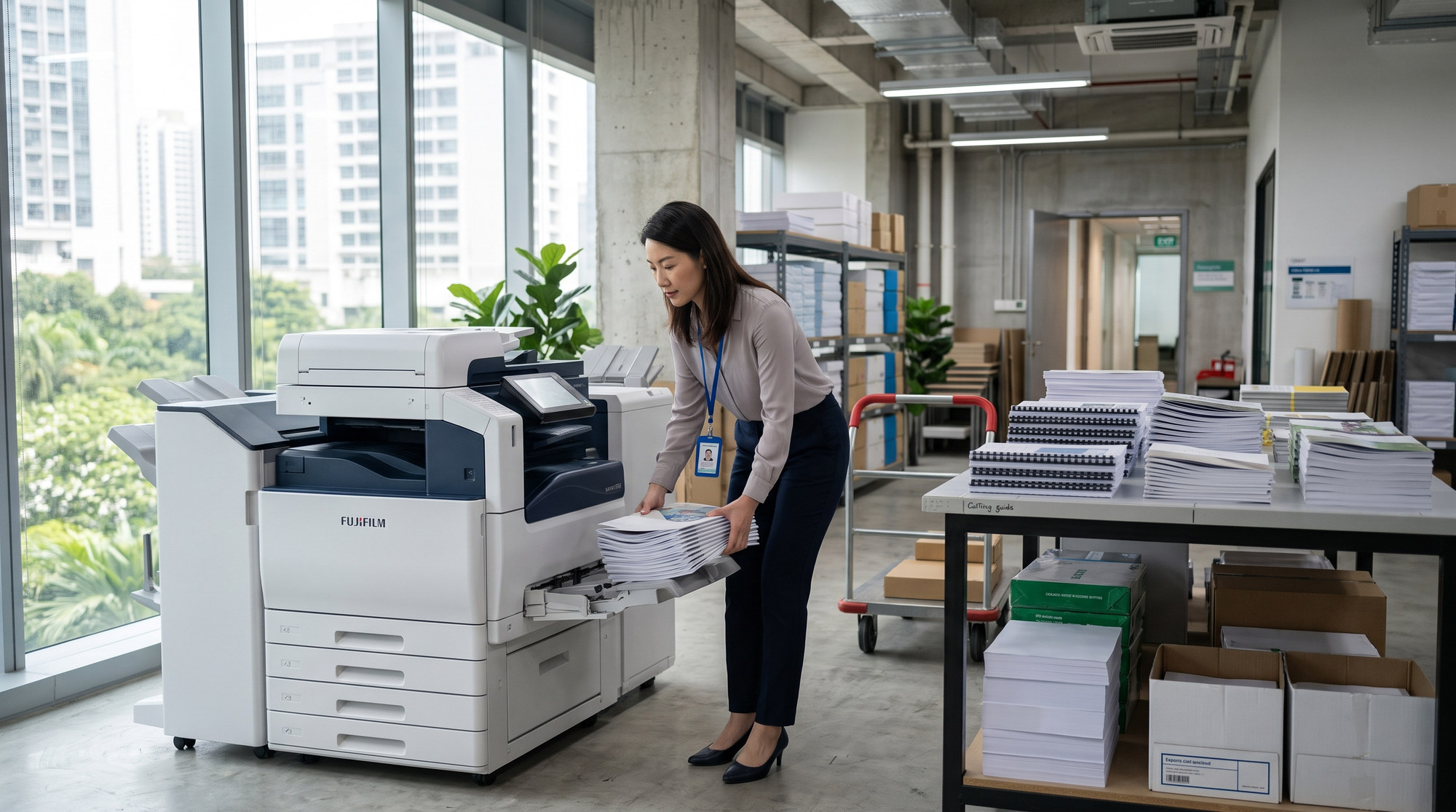
Every general office and corporate admin team in Singapore arrives at the same question eventually. The print bills have been climbing, the turnaround from the external vendor is not keeping up with the deadlines, and somebody raises the obvious idea: should we just bring this in-house?
It is the right question and it usually gets answered too broadly. "Printing" is not one activity — exam papers, booklets, brochures, name cards and posters have almost nothing in common in terms of volume, finishing, deadline pressure and confidentiality. The sensible approach is to split the work by job type and decide each one separately. This guide sets out how schools and corporates should think about outsourcing to a commercial printer in Singapore versus running production equipment themselves, and what tips the decision either way.
Start With the Job Mix, Not the Machine
Before comparing quotations, spend an hour listing what your organisation actually prints over a year, with rough volumes and deadlines against each. Most print requirements fall into three groups, and each group has a different answer.
- Routine high-volume work. Worksheets, assessment papers, circulars, training manuals, internal reports, meeting packs. Predictable, mostly mono or light colour, no exotic finishing, and recurring throughout the year.
- Short-run colour work. Programme booklets, newsletters, course brochures, departmental presentations, proposal documents. Lower quantities, higher colour expectations, and often needed at short notice.
- Specialty and finishing-heavy work. Yearbooks with perfect binding, name cards on textured stock, roll-up banners, posters on synthetic substrates, laminated certificates, die-cut or foiled pieces. Infrequent, technically demanding, and judged on appearance.
The first group is where in-house equipment earns its keep. The third is almost always better outsourced. The second is where the real decision lies, and where the answer depends on your deadlines more than your volumes.
A school that treats "printing" as one line item ends up either paying external rates for 200,000 worksheets or trying to produce a perfect-bound yearbook on an office machine. Both are avoidable.
When Outsourcing Is the Right Call
Outsourcing wins wherever the job needs capability you would use only occasionally.
Specialty substrates and finishing. Perfect binding, saddle-stitching at thickness, foiling, spot UV, die-cutting, synthetic and textured stocks — these need dedicated equipment and an operator who uses it daily. Buying that capability for two jobs a year cannot be justified, and the output of an occasional user rarely matches a production house.
Large, infrequent runs. A one-off run of several thousand brochures is usually cheaper offset or on a commercial digital press than on an office device, once you account for click charges, operator time and the machine being unavailable for everything else while it runs.
Peak overflow. Even organisations with capable in-house equipment should keep an external vendor on standby. Exam season, orientation week and financial year-end all compress demand into a narrow window, and a single machine going down during that window is a real operational risk.
Anything judged on appearance by an outsider. Prospectuses, annual reports, award submissions and client-facing proposals are documents where professional colour print quality is part of the message. Colour-managed production output and proper stock selection are visible to the recipient in a way internal documents are not.
No capital, no staffing, no space. Outsourcing has zero fixed cost. No floor space in an admin block that does not have any to spare, no capital approval, no staff member who becomes the de facto print operator on top of their actual job.
When an In-House Production Printer Pays Off
In-house wins on the work you do constantly, and on anything where control matters more than finish.
Unit cost at sustained volume. External printing is priced per piece with a margin on every one. A production device is priced on a cost-per-page basis that falls as volume rises. The crossover point depends on your mix, but organisations printing consistently through the year usually find that routine work is substantially cheaper produced internally once the machine is paid for by the volume it absorbs.
Turnaround and late amendments. This is the argument that actually persuades people. An external job has a submission deadline, a queue and a delivery window. An amendment discovered the evening before means a reprint, a new charge and a new lead time. In-house, a corrected file is reprinted in an hour. For anything with a fixed date — a parents' briefing, a board meeting, a tender submission — that difference is the whole case.
Confidentiality and personal data. Examination papers, student records, staff appraisals, board packs and tender pricing are documents that should not leave the building casually. Under the PDPA, engaging an external vendor to process documents containing personal data makes that vendor a data intermediary — and the organisation that engaged it remains responsible for compliance. Keeping sensitive print internal removes the transfer, the contractual safeguards and the audit question entirely. For schools in particular, the security of examination material is usually reason enough on its own.
Consistency and ad-hoc capacity. Running a photocopy machine in Singapore at production grade means your departmental brochures, signage and handouts come off the same colour-calibrated device every time, rather than varying between whichever vendor was cheapest that quarter. It also means the capacity exists for the unplanned job nobody budgeted for.
The Split Most Organisations Actually Land On
In practice, very few Singapore schools or corporates go fully one way. The arrangement that tends to hold up looks like this: routine and confidential work produced in-house on a production-capable device, specialty and finishing-heavy work outsourced, and a standing relationship with an external printer for peak overflow and anything that exceeds the in-house machine's capability.
That split also makes the equipment decision easier, because you are no longer trying to buy a machine that does everything. You are buying one sized to your routine volume, with the finishing options your recurring jobs actually need.
Five questions settle it for most organisations:
- What is the annual volume of your routine work? Count pages, not jobs. Consistent high volume is the strongest argument for in-house; sporadic volume is the strongest argument against.
- How often are your deadlines immovable? If late amendments and fixed dates are a recurring feature, in-house turnaround is worth paying for.
- Does your print include personal or confidential data? If a meaningful share does, that work should be internal regardless of what the cost comparison says.
- What finishing do you genuinely need recurring? Stapling and hole-punch are standard on a production device. Perfect binding and specialty substrates are not — do not buy for a job you run once a year.
- Who will operate it, and where will it go? A production device needs a named owner, basic training, floor space with clearance, and a proper power supply. If none of those can be committed, outsourcing is the honest answer.
The useful thing about this decision is that it is not permanent. Outsource while volumes are uncertain, review the spend after a year, and bring the routine work in-house once the numbers justify it. Organisations that commit early in either direction are the ones that end up stuck.
ASC Marketing sits on both sides of this. We run commercial printing services for exam papers, booklets, brochures, name cards and posters, and we supply and service the production printer range for organisations bringing that work in-house — including schools and institutions such as the National Institute of Education and Hwa Chong Institution, where confidentiality and fixed deadlines are routine rather than exceptional. That means we have no particular interest in pushing you one way.
Related reading: Document Binding Services for Business Growth | Large Format vs Commercial Printers
Not sure which side of the line your print sits on? Send us your job mix and annual volumes — we will tell you honestly what is worth outsourcing and what is worth producing yourself. See our commercial printing services and production printer range, or contact our team to talk it through.
🏢 Address: 10 Upper Aljunied Link, #07-07, Singapore 367904
📞 Tel: +65 6291 3133
🌐 Website: https://www.asc-svc.com/contact
References
- Personal Data Protection Commission — Advisory Guidelines on Key Concepts in the Personal Data Protection Act: Explains the role of a data intermediary and confirms that an organisation engaging one to process personal data on its behalf retains the same obligations under the PDPA. URL: https://pdpc.gov.sg/Guidelines-and-Consultation/2020/03/Advisory-Guidelines-on-Key-Concepts-in-the-Personal-Data-Protection-Act
