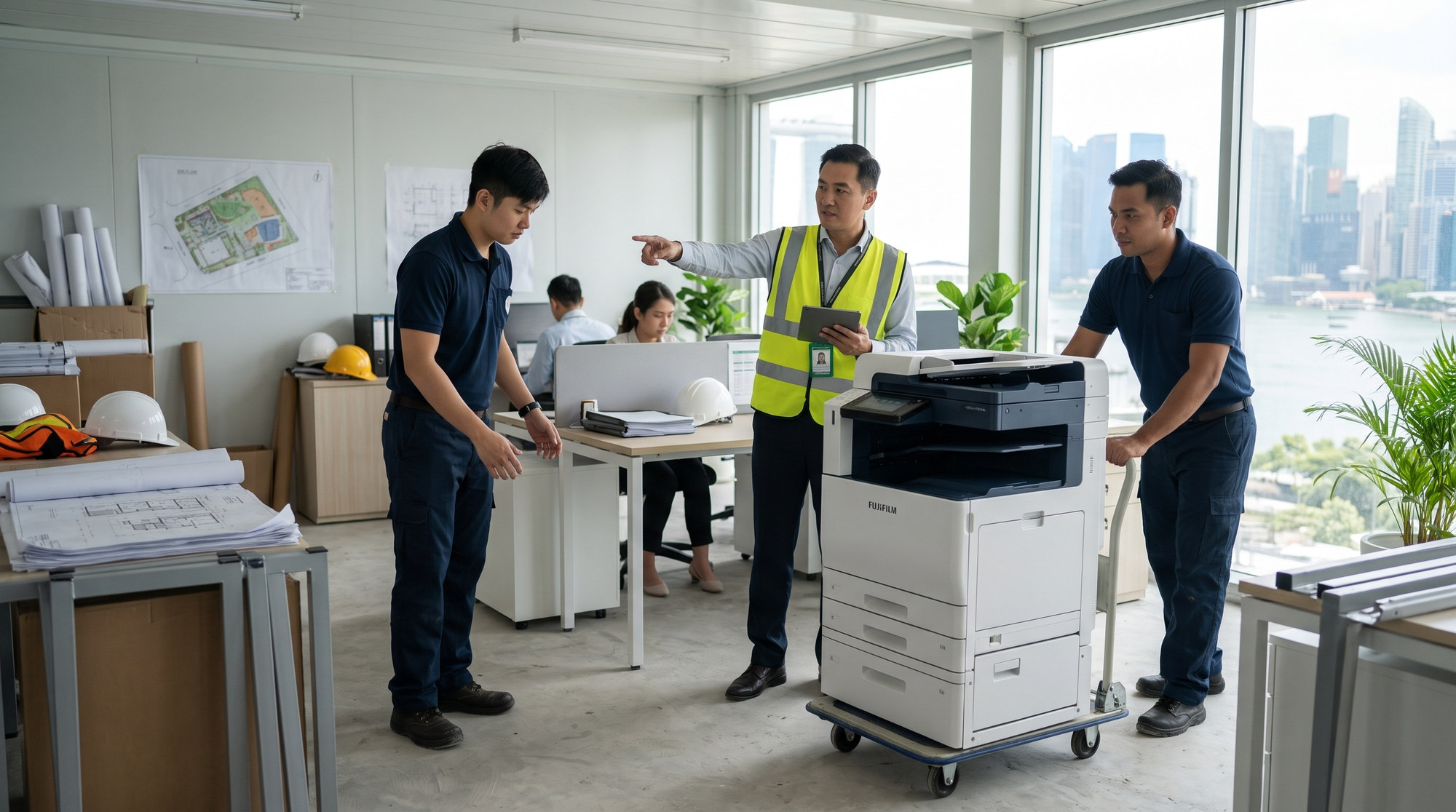
Not every printing requirement lasts three years. A site office at a Build-To-Order project closes when the project tops out. A roadshow at Suntec runs for four days. An exam season fills a school's general office for six weeks and then goes quiet. In each case, the standard answer from most vendors — a 36 or 60-month lease on a machine you will still be paying for long after the need has gone — solves the wrong problem.
Short-term hire exists for exactly these situations, and it is widely misunderstood as simply "renting, but worse". In practice it is a different commercial product: a defined period, an all-in monthly rate, and a machine that leaves when you are done with it. If you are weighing photocopier rental for a temporary need in Singapore, this guide covers when hire genuinely beats buying, what the rate should include, and the local logistics that catch most first-time renters off guard.
When Short-Term Hire Beats Buying or a Long Lease
The test is simple: if the need has an end date, the contract should have one too. Five situations come up repeatedly among Singapore businesses.
- Project and site offices. A main contractor's site office on a construction project exists for the life of the project. Drawings, permits, toolbox meeting records and daily reports all need printing on site, often in A3. Committing to a five-year lease for a container office that will be demobilised is a straightforward mismatch, which is why a copier machine on rent is the standard arrangement on most sites.
- Temporary and swing offices. Commercial leases in Singapore turn over constantly, and fit-out works rarely finish on schedule. Companies moving between units, or operating from a serviced office for a few months while renovation completes, need a working machine in the interim without touching their existing fleet.
- Exam and year-end print peaks. Schools and institutions see concentrated volumes around national examination periods and the start of each academic year. Corporates see the same spike at financial year-end, when annual reports, audit schedules and AGM papers all land at once. One extra machine for eight weeks is cheaper and less disruptive than oversizing the permanent fleet for a peak that occurs twice a year.
- Events, roadshows and exhibitions. Exhibitors at Singapore EXPO, Suntec and Marina Bay Sands need on-site printing for registration lists, name cards, collateral reprints and last-minute amendments. Venue business centres charge per page and keep their own hours; a unit in your own booth does not.
- Covering a breakdown. If a core machine is out for a major repair or awaiting a part, a short-term unit keeps the office running instead of sending staff to a neighbouring floor with a thumb drive.
What You Are Actually Paying For
The sticker comparison — monthly rental versus purchase price — misses most of what makes hire the cheaper option over a short horizon.
A purchased machine is only the start of the spend. You also take on toner and drum replacement, a service contract or ad-hoc call-out charges, the technician's time, and eventually the question of what to do with a depreciated asset nobody wants to buy. A properly structured copier machine rental agreement folds delivery, installation, servicing, parts and consumables into a single predictable figure, and ends with the supplier collecting the machine.
The accounting treatment matters too, particularly for SMEs managing working capital. Buying a copier is capital expenditure — IRAS does not treat the purchase of plant and machinery as an allowable deduction against income, though capital allowances may be claimed separately. Rental payments incurred in running the business are an operating expense. Your accountant or tax agent should confirm the correct treatment for your situation, but the cash-flow effect is not in dispute: hire converts a lump sum into a monthly line item, and frees capital for stock, payroll or the project itself.
There is also an obsolescence argument. Office hardware moves quickly — cloud scanning, mobile release, tighter security defaults. A short contract means you are never the company still running a machine three generations behind because the lease has two years to go.
What to Confirm Before You Sign
Short-term agreements vary far more between suppliers than long leases do. Five things are worth pinning down in writing.
- Machine specification against real volume. Estimate your monthly page count honestly, then check it against the machine's recommended monthly volume — not its maximum duty cycle, which is a peak rating rather than a sustainable one. Confirm whether you need A3 or A4 only, colour or mono, and whether finishing matters: stapling, hole-punch, and booklet-making are the features people discover they needed after delivery.
- What the rate includes. Ask specifically whether delivery, installation, network configuration, staff orientation and end-of-term collection are in the monthly figure or billed separately. Collection is the one most often omitted.
- Consumables and meter charges. Most agreements include toner but exclude paper and staples. Clarify whether a page allowance is bundled, what the excess rate is per mono and colour page, and how meter readings are taken — automatically by the device, or by someone reading the counter each month.
- Service response and what it covers. Establish the response commitment for a breakdown, whether parts and labour are included, and what happens if a machine cannot be repaired on site. For a time-critical deployment, ask whether a replacement unit is provided.
- Term, extension and exit. Confirm the minimum period, whether billing is pro-rated if the project finishes early, what the extension terms are if it overruns, and the notice required for collection. Projects slip; an agreement that cannot flex with yours will cost you either way.
Local Logistics Most First-Time Renters Overlook
A short-term deployment lives or dies on the delivery day. These are the practical constraints that routinely delay installations in Singapore.
- Service lift booking and loading bay access. Most commercial and industrial buildings here require the service lift to be booked in advance through building management or the MCST, often with restricted delivery windows and a refundable deposit. An A3 multifunction device is heavy and bulky enough that the passenger lift is not an option. Confirm the booking before the delivery date is fixed, not after.
- Permits and site access. Construction sites and secured premises add their own layer — a permit-to-work, a vehicle entry pass, or escorted access for the delivery crew. Government and institutional sites may require security clearance for technicians in advance.
- Power and placement. A production-class machine should run from its own 13A point, not a shared extension board. Check the socket location before you decide where the machine goes, and leave clearance at the rear and sides for servicing and paper tray access.
- Humidity and paper storage. Singapore's year-round humidity is a genuine cause of paper curl, misfeeds and jams. Keep reams sealed until use, store them off the floor and away from direct airflow, and avoid leaving an opened pack in the tray over a long weekend. This single habit prevents a large share of "the machine is faulty" call-outs.
- Network and data security. Agree in advance who configures the IP address, scan-to-email and any directory integration, and whether your IT team requires sign-off. Before collection, confirm in writing that the device's storage will be wiped or overwritten — a rented machine that has scanned staff records or client files carries personal data, and responsibility for it under the PDPA does not end when the unit leaves your office. A supplier offering a professional printer rental service should raise this before you have to ask.
Short-term hire is not a compromise on quality. The machines are the same models that go into permanent installations, and the servicing obligation is the same — the only difference is the length of the commitment and the fact that the supplier, not you, owns the asset at the end.
As a Fujifilm Authorised Dealer, ASC supplies and services equipment for schools, government agencies and enterprises across Singapore, including the National Institute of Education, Hwa Chong Institution, NParks and BYD. Rental machines are serviced by our local technical team, so a short-term rental receives the same standard of support as a long-term installation.
Related reading: Photocopier Rental Costs in Singapore | Buying vs Renting an Office Copier
Need a copier for a fixed period rather than a fixed term? Tell us the volume, the duration and the site, and we will quote a machine that fits — see our rental options or contact our team for a quotation.
🏢 Address: 10 Upper Aljunied Link, #07-07, Singapore 367904
📞 Tel: +65 6291 3133
🌐 Website: https://www.asc-svc.com/contact
References
- Inland Revenue Authority of Singapore — Business Expenses and Deductions: IRAS guidance on the "wholly and exclusively incurred in the production of income" test, including the treatment of capital expenditure such as the purchase of plant and machinery, which is not an allowable business expense. URL: https://www.iras.gov.sg/taxes/individual-income-tax/self-employed-and-partnerships/business-expenses-and-deductions
