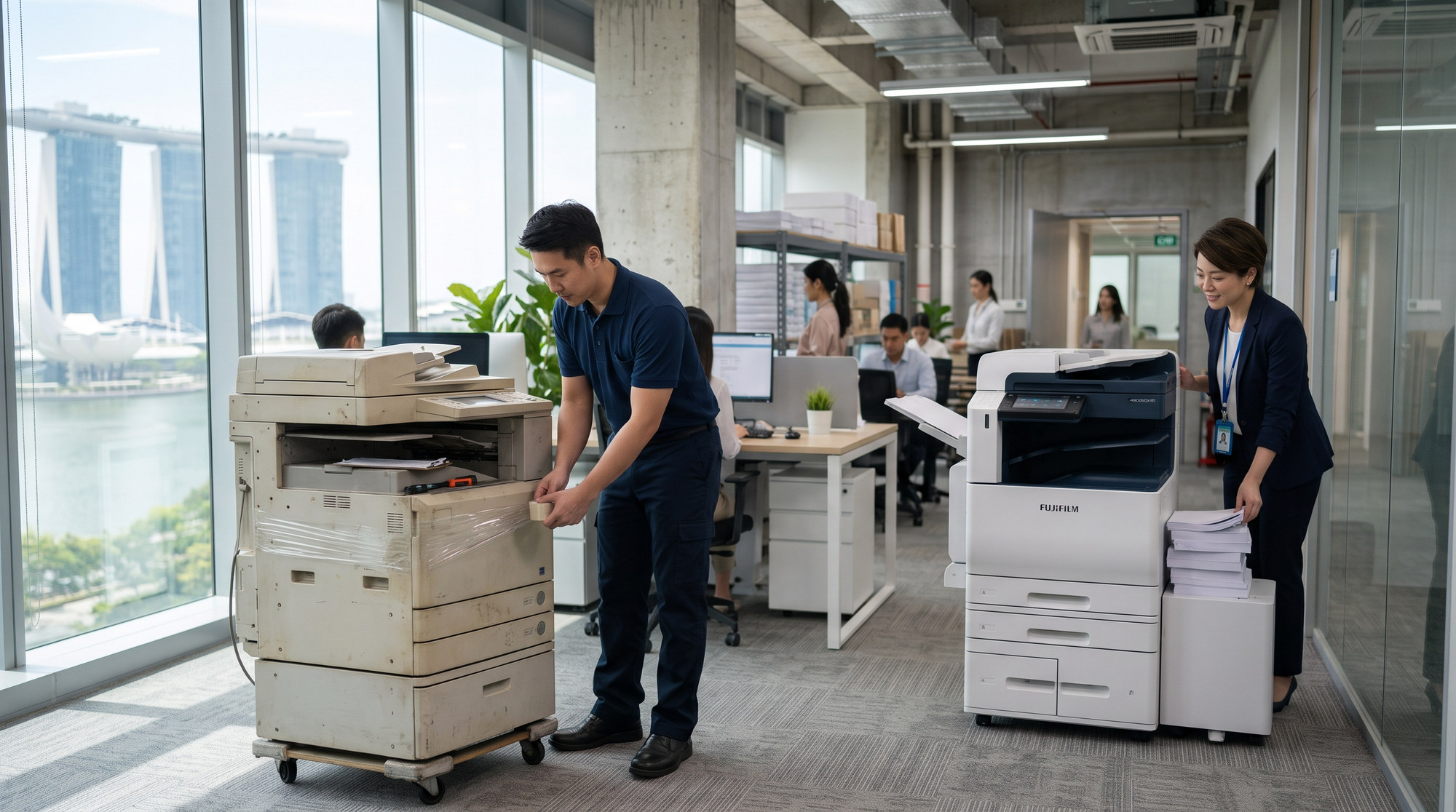
The machine still works. That is usually the problem. An ageing office copier rarely fails outright — it just gets slower, jams more often, costs more per page, and quietly absorbs more of someone's week than anyone has measured. Because it still works, the replacement request keeps getting deferred.
What often unblocks it is discovering the old machine is worth something. A trade-in or buyback programme converts the unit you were planning to dispose of into a reduction on the new one, which changes the shape of the approval from a capital request into a net figure. This article covers when replacement is genuinely due, how trade-in and buyback differ, what actually sets the value of a used machine, and the GST, data and disposal details Singapore buyers tend to discover too late.
Signs the Machine Is Actually Due
"Still working" is not the threshold. These are the signals that the economics have already turned.
- Cost per page is climbing. Older devices need more frequent drum, roller and fuser replacement, and the parts cost more as they become scarce. Pull the last twelve months of service invoices and divide by pages produced — the trend line is usually clearer than anyone expects.
- Service calls are routine rather than exceptional. A machine that jams weekly is costing you staff time nobody is invoicing for. Two or three interruptions a week across a department adds up to more than the monthly cost of newer equipment.
- Parts or firmware support is ending. Manufacturers support models for a defined period after discontinuation. Once that window closes, parts come from refurbished stock and firmware stops being updated — which matters more than it sounds, because a networked copier machine in Singapore sits inside your corporate network and unpatched firmware is a live security exposure.
- It does not fit how people work now. No scan-to-cloud, no mobile release, no support for the authentication method your IT team has standardised on. Staff work around the machine instead of with it, usually by emailing scans to themselves.
- Output quality is drifting. Banding, colour inconsistency and fusing problems that return shortly after each service call generally indicate wear that servicing can only defer.
If three or more of these apply, the question is no longer whether to replace but how to make the numbers work.
Trade-In, Buyback and Take-Back Are Three Different Things
The terms get used interchangeably in sales conversations. They are not the same arrangement and they do not have the same accounting or commercial consequences.
Trade-in is the common one: the supplier assigns a value to your old machine and offsets it against the price of the new equipment. You pay the difference. It is simple, it reduces the capital figure going to finance, and the old unit leaves as part of the same transaction.
Buyback is an outright purchase of the old machine, independent of whether you buy new equipment from the same supplier. This matters if you are consolidating a fleet, closing an office, or switching to rental rather than purchase — there is no new device to offset against, so you want cash or a credit note instead.
Take-back applies when the machine has no residual value, which is common for units past manufacturer support or with very high meter counts. There is no payment, but the supplier removes and disposes of the equipment responsibly. This is still worth arranging rather than handling yourself, for reasons covered further below.
The practical point: ask which of the three you are being offered, in writing. A quotation showing a "$X discount" is not the same as a trade-in valuation, and the difference shows up later in your accounting.
What Determines the Value of Your Old Machine
Valuation is not arbitrary, and knowing the inputs lets you present your machine properly rather than accepting the first figure.
- Meter count against rated life. The single biggest factor. A device's total page count relative to its designed lifespan tells a buyer how much working life remains. Two machines of the same age can differ enormously here.
- Model and ongoing support. A unit still within the manufacturer's parts and firmware support window is worth considerably more than one past it, because it can be refurbished and resold with a warranty rather than stripped for parts.
- Service history. A machine with a documented maintenance record from an authorised service provider carries a higher valuation than an identical unit with no history. Keep the service reports — they are part of the asset.
- Whether genuine consumables were used. Long-term use of compatible toner leaves evidence inside the machine: fuser wear, drum scoring, contamination in the developer unit. Assessors look for it, and it reduces value.
- Physical condition and completeness. Panel damage, missing trays, a removed finisher or absent power cables all reduce the figure. Gather every accessory that came with the device, including the ones currently in a store cupboard.
- Market demand for the model. Common workhorse models with an active secondary market in Singapore hold value better than niche or heavily specified configurations.
Two practical steps before a valuation visit: print the meter report so the assessor is not estimating, and have the machine cleaned and the trays reinstalled. A unit that presents as maintained gets assessed as maintained.
The Compliance Side Singapore Buyers Forget
Three items regularly surprise finance and admin teams after the deal is agreed.
GST treats a trade-in as two separate supplies. This catches out GST-registered businesses constantly. IRAS does not treat a trade-in as a discounted sale — it treats it as two transactions: the supplier selling you the new equipment at its full price, and you selling the old equipment to the supplier at the trade-in value. The supplier charges GST on the full price of the new machine, not the net difference. If your business is GST-registered, you are making a taxable supply of your old asset and should issue a tax invoice to the supplier for the trade-in value. Budget against the full price, not the net figure, or the cash requirement will be higher than approved.
Disposal affects your capital allowances. If capital allowances were claimed on the old machine, disposing of it generally triggers a balancing adjustment in that year of assessment. Your tax agent should factor this in before the transaction, not after. It rarely changes the decision, but it does change the year's numbers.
The storage drive leaves with the machine. Modern multifunction devices retain scanned and printed documents, address books, stored mailboxes and user credentials. A photocopier in Singapore that has handled staff records, student data or client files is carrying personal data, and your obligations under the PDPA do not end when it goes out the door. Require written confirmation that the drive will be securely overwritten or physically destroyed, and ask for a certificate. Clear the address book and stored mailboxes yourself before collection as well.
On disposal more broadly, Singapore's regulated e-waste framework places collection obligations on producers of regulated non-consumer electrical and electronic products — they are required to take back unwanted products supplied to their clients for proper treatment. Routing an old copier through a supplier with a defined take-back process is both the compliant route and the easier one.
Planning the Switch-Over
The changeover itself is where a well-negotiated deal can still go badly. Most of the risk is logistical and entirely avoidable.
- Sequence delivery before collection. Insist on an overlap, even a few hours. If the old machine leaves in the morning and the new one arrives in the afternoon, any delay leaves the office without a copier for a day. A short overlap also lets you confirm the new unit works before the old one is gone.
- Book the service lift once, for both movements. Building management in most Singapore commercial and industrial premises requires advance booking with restricted delivery windows. Two machines moving on the same day means two bookings, or one long enough window to cover both.
- Prepare the network side in advance. Agree who assigns the IP address, who configures scan-to-email through your mail server, and who deploys drivers to users. Ask whether scan destinations, address books and department codes can be exported from the old device and imported to the new one — this saves hours of re-entry.
- Account for leftover consumables. Unopened toner for the outgoing model is dead stock once it leaves. Run down your stock ahead of the changeover, or ask whether the supplier will take unopened cartridges as part of the deal.
- Schedule the orientation. Thirty minutes with the staff who use the machine most — the general office, admin executives, the reception team — prevents weeks of the new device being used at a fraction of its capability. Book it for a day or two after installation, once people have hit their first question.
Put the sequence in the purchase order: delivery date, installation date, orientation date, collection date, and the data-wipe certificate. A supplier that can commit to all five in writing is one that has done this before.
An upgrade that nobody can get approved is not a saving. Treating the old machine as an asset rather than a disposal problem usually moves the figure enough to change the conversation with finance, and it removes the awkward question of what to do with a two-hundred-kilogram device nobody wants.
ASC Marketing assesses trade-ins across Fujifilm and other office equipment brands, and manages the replacement from valuation through to installation of your new unit. As an authorised Fujifilm dealer we can also tell you honestly when a machine is worth keeping for another year — which is occasionally the right answer.
Related reading: Refurbished Copiers in Singapore | Security Measures in Modern Fujifilm Copiers
Wondering what your current machine is worth? Tell us the model and meter reading and we will give you an indicative valuation before you commit to anything. See our trade-in and buyback programme, browse current equipment, or speak to our team.
🏢 Address: 10 Upper Aljunied Link, #07-07, Singapore 367904
📞 Tel: +65 6291 3133
🌐 Website: https://www.asc-svc.com/contact
References
- Inland Revenue Authority of Singapore — Trade-Ins (GST): Confirms that a trade-in is treated as two separate supplies for GST purposes, with the supplier charging GST on the full selling price rather than the net difference, and a GST-registered customer accounting for GST on the trade-in value. URL: https://www.iras.gov.sg/taxes/goods-services-tax-(gst)/charging-gst-(output-tax)/common-scenarios---do-i-charge-gst/trade-ins
- National Environment Agency — Extended Producer Responsibility (EPR) System for E-waste Management: Sets out Singapore's regulated e-waste framework, including the requirement for producers of regulated non-consumer products to collect unwanted products supplied to their clients for proper treatment. URL: https://www.nea.gov.sg/our-services/waste-management/3r-programmes-and-resources/e-waste-management/extended-producer-responsibility-(epr)-system-for-e-waste-management-system
