Two quotations land on a procurement officer's desk for what looks like the same A3 multifunction copier. One is noticeably cheaper. The temptation to take it is entirely rational — until you find out what the gap actually represents.
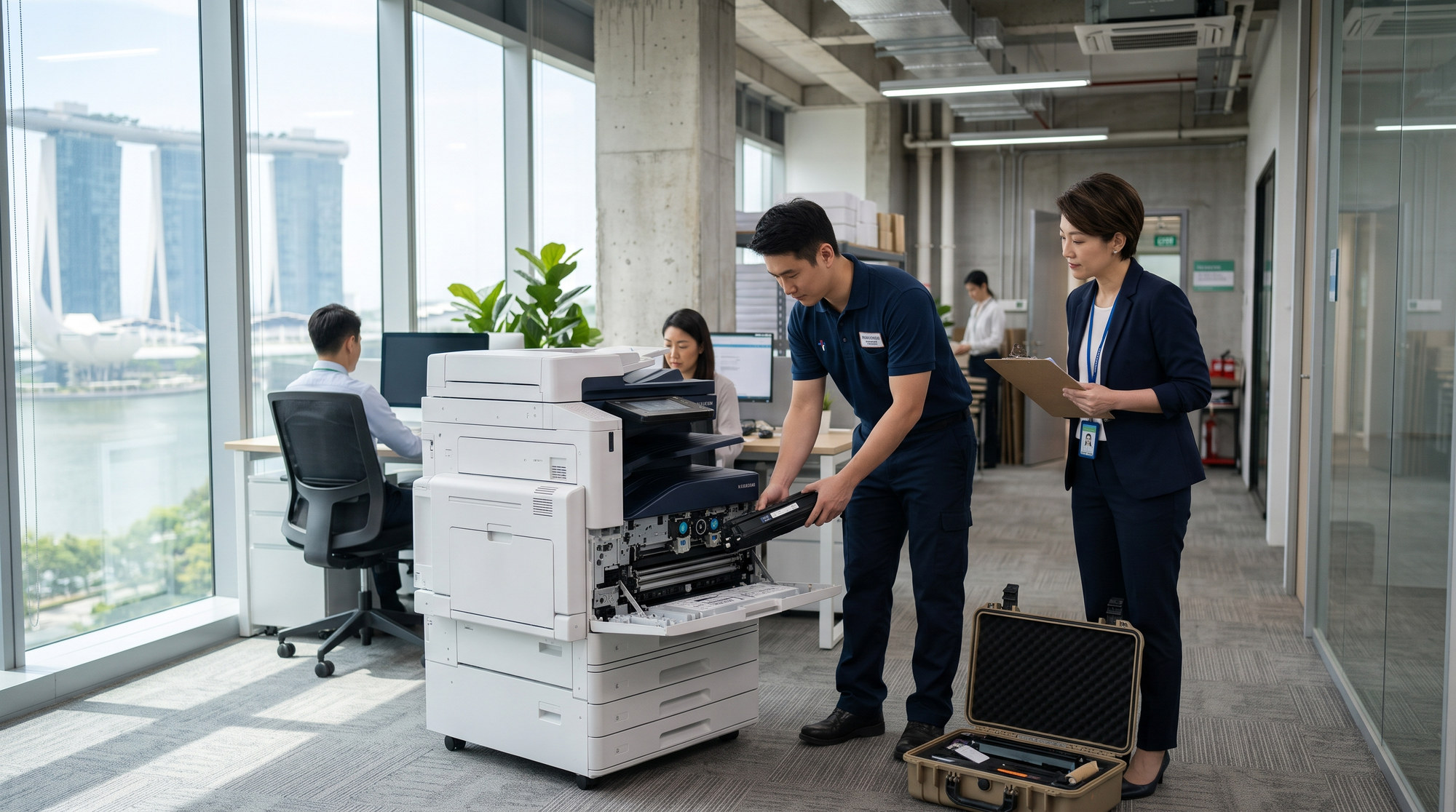
In most cases the difference is not margin. It is warranty standing, access to genuine parts, a technician certified to open the machine, and someone contractually obliged to still be there in year four. Buying from an authorised Fujifilm dealer in Singapore is not about brand loyalty; it is about who carries the obligation when something goes wrong. This article sets out what the credential actually covers, what an unofficial reseller cannot replicate, and the specific checks you can run on any dealer before you commit.
What "Authorised Dealer" Actually Means
The phrase gets used loosely in marketing copy, so it is worth being precise. An authorised dealer holds a formal appointment from the manufacturer to sell and support its products in a defined market. It is a contractual relationship with conditions attached, not a self-declared label.
In practice, that appointment carries four things an unappointed seller does not have.
- A direct supply line. Machines, spare parts and consumables come through the manufacturer's official distribution channel, with the serial numbers registered for the Singapore market.
- Trained technicians. Service staff are put through manufacturer training on specific model families, and re-trained as firmware and hardware change. This is why an authorised service team can open a machine without voiding anything.
- Standing to honour warranty. Warranty is a claim against the manufacturer, administered through its appointed channel. A dealer outside that channel has no mechanism to process one.
- Accountability to the brand. Authorisation can be withdrawn. That gives a dealer a commercial reason to resolve problems rather than absorb complaints, which is a quieter benefit but a real one.
An important clarification for Singapore buyers: an authorised dealer is an independent company appointed by the manufacturer. It is not the manufacturer's own local corporate entity, and it should not present itself as one. A dealer that blurs this line is already telling you something about how it handles accuracy.
What You Get That an Unofficial Reseller Cannot Provide
A copier is not a one-off purchase. It is a multi-year relationship with a machine that needs consumables, parts, firmware and someone to fix it. The dealer credential matters most in years two through six.
- A warranty that can actually be claimed. Registered through the official channel, against a machine with a Singapore-market serial number. A parallel-imported unit may carry a warranty valid in another country and nowhere useful to you.
- Genuine consumables and parts. A fujifilm copier is engineered around specific toner chemistry, drum coatings and fuser temperatures. Non-genuine toner is a common cause of avoidable damage: under-fused output, drum scoring, waste toner overflow, and in the worst cases a costly fuser assembly replacement.
- Firmware, drivers and security updates. Manufacturers release firmware for security vulnerabilities and OS compatibility. Access routes through the official support channel, and matters more than most buyers expect — network-connected MFDs sit inside the corporate network and are a recognised attack surface.
- Parts availability across the machine's life. Rollers, fusers, separation pads and drums are consumable by design. An authorised dealer orders them against the model; an unofficial seller sources whatever is on the open market, which is where counterfeit parts enter.
- Proper installation and integration. Setting up scan-to-email through a corporate mail server, joining a device to a domain, configuring secure print release, or getting a fujifilm printer singapore deployment to work with existing print management software is specialist work. Getting it wrong is how a machine ends up used as a photocopier only.
- End-of-life take-back. Under Singapore's Extended Producer Responsibility framework, producers of regulated non-consumer electrical and electronic products — which includes commercial ICT equipment — are required to collect unwanted products from their clients for proper treatment. An official channel has a defined route for this; an unofficial one leaves disposal as your problem.
Where the Savings Actually Come From
Parallel-import and grey-market machines are not usually fake. They are typically genuine units brought in outside the official channel, which is precisely where the discount comes from — and where the exposure sits.
The first issue is support orphaning. A machine without a local warranty registration is one nobody is obliged to service. When it fails, you are negotiating a chargeable repair from a standing start, often with a technician who has not been trained on that model.
The second is configuration mismatch. Units intended for another market may ship with different power specifications, region-locked firmware, or a control panel language set that cannot be changed without service-level access. Driver packages and management software may not match the version your IT team supports.
The third is consumables. Grey-market hardware tends to come with grey-market toner, and this is where most of the real damage occurs. Counterfeit cartridges are sold in convincing packaging and are common enough in the region that a visual check is not sufficient.
The fourth is the one procurement teams discover last: resale and disposal. A machine with no documented purchase channel and no service history is difficult to trade in, and you lose the take-back route that comes with an official supplier. For an organisation with an environmental policy — or one following SS 587, the Singapore Standard for managing end-of-life ICT equipment — that is a compliance gap, not just an inconvenience.
None of this means the discount is never worth it. It means the comparison should be total cost over the machine's working life, not the figure on the quotation.
How to Verify a Dealer Before You Buy
Every check below takes minutes, costs nothing, and is entirely reasonable to ask of any vendor. A dealer that hesitates on these has answered the question for you.
- Ask for the authorisation document. Request the dealership certificate or appointment letter, and check that it covers the current period and the product line you are buying. Dealer status is renewed, not permanent.
- Check the company on Bizfile. ACRA's Bizfile portal lets you search any Singapore entity free by name or UEN and see its registered name, status and address. Confirm the trading name on the quotation matches a live registered entity, and that the UEN on the quotation is the same one.
- Ask where the machine is coming from. A direct question — is this unit supplied through the official Singapore channel, with a local warranty registered to our company — should get a direct answer in writing.
- Get the consumables commitment in writing. Ask the vendor to state in the quotation or service agreement that genuine parts and consumables will be used throughout the contract. Verbal assurance is not a term.
- Ask about the technicians. How many service engineers does the company employ directly, rather than subcontract? Which model families are they trained on? What is the response commitment, and is it in the agreement or just on the website?
- Look for third-party validation. Manufacturer awards, service accreditations and a verifiable client list are harder to fake than a logo on a website. Ask for reference customers in your own sector — a school will want to hear from another school.
- Check how long they have been doing it. Dealer appointments are not awarded casually and are not retained by companies that generate complaints. Longevity in the channel is itself evidence.
The dealer credential is not a marketing badge. It is the mechanism by which warranty, parts, training and accountability reach you — and the reason a cheaper quotation from outside the channel is usually cheaper for a reason you will meet later.
ASC Marketing is an authorised Fujifilm dealer supplying and servicing office equipment across Singapore, with a local technical team and a client base that includes the National Institute of Education, Hwa Chong Institution, NParks and BYD. Institutional buyers of that kind run the checks above as standard, which is a reasonable proxy for whether a vendor survives them.
Related reading: How to Choose a Reliable Office Equipment Supplier in Singapore | Security Measures in Modern Fujifilm Copiers
Want to run those checks on us? Start with our company background and awards and certifications, then speak to our team about dealership documentation and reference clients.
🏢 Address: 10 Upper Aljunied Link, #07-07, Singapore 367904
📞 Tel: +65 6291 3133
🌐 Website: https://www.asc-svc.com/contact
References
- National Environment Agency — Extended Producer Responsibility (EPR) System for E-waste Management: Sets out Singapore's regulated e-waste framework, including the requirement from 1 July 2021 for producers of regulated non-consumer products to collect unwanted products supplied to their clients. URL: https://www.nea.gov.sg/our-services/waste-management/3r-programmes-and-resources/e-waste-management/extended-producer-responsibility-(epr)-system-for-e-waste-management-system
- Accounting and Corporate Regulatory Authority — Using Bizfile's Search Functions: ACRA's guide to the free entity search, used to verify a Singapore company's registered name, UEN, status and address before engaging it. URL: https://www.acra.gov.sg/resources/guides-forms/using-bizfiles-search-functions/
